
Hotel Door Lock Buying Guide 2026: Six Decisions That Decide Your Project
Most hotel door lock projects do not fail at installation. They fail earlier, at the specification stage: a lock chosen for its looks, a card technology that does not match the front-desk workflow, or a mortise that turns out not to fit half of the doors on the floor. This guide breaks the purchase into six decisions, in the order our project customers usually meet them. Work through them in sequence and the quotation you receive at the end will actually be comparable across suppliers.
One note on transparency before we start: where we cite market data or security research, we link the third-party source. Where we describe how hotel locks behave in daily operation, we draw on questions and failures our own project customers have run into over years of supplying RFID hotel lock systems to hotels, serviced apartments and resort properties.
The short answer
For most properties between roughly 30 and 150 rooms, an offline RFID card lock on a standard mortise body, issued by front-desk encoder software, is still the most reliable and lowest-risk choice. Step up to a networked lock (Bluetooth or Wi-Fi, with a gateway) only when you specifically need remote credential issuing, mobile keys or real-time audit trails, and budget for the network work that comes with it. Choose 13.56 MHz Mifare cards over 125 kHz cards for any new build. Everything below explains why.
Decision 1: Hotel-grade or residential smart lock?
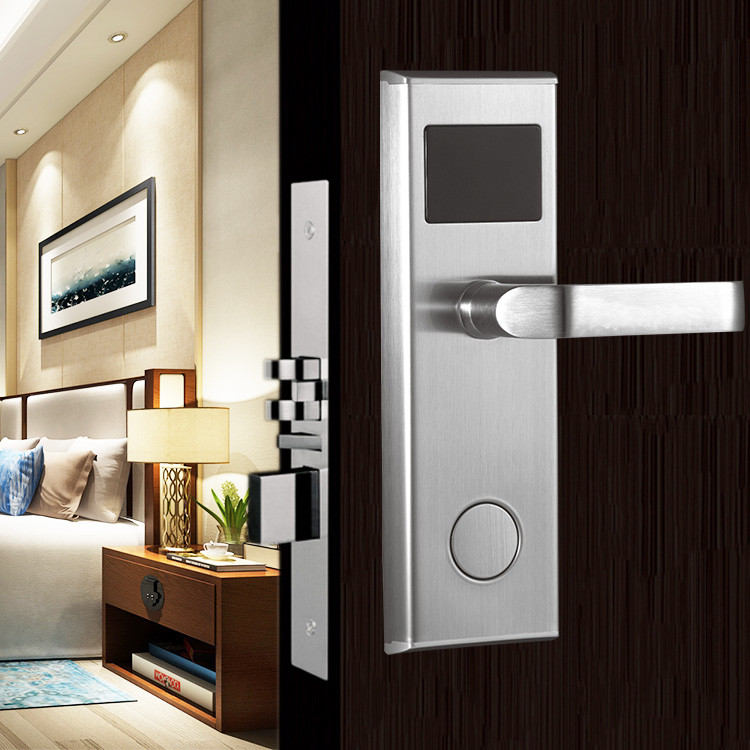
Residential and hotel locks share a name and little else. A home lock faces one family for ten years; a hotel lock faces hundreds of groups of strangers every year, plus housekeeping, engineering and management staff, each of whom needs a different level of access. The operational requirements that matter are:
- Credential lifecycle. A guest card must expire automatically at check-out, with no manual step. A residential lock has no concept of a check-out date.
- Permission tiers. Guest card, floor card for housekeeping, and a controlled master card for management. Each tier needs its own issue-and-revoke workflow and a sign-out log.
- High-frequency duty. Guest room doors are opened and closed far more often than home doors, which drives battery consumption and mechanical wear.
- Audit trail. Every opening event should be recorded with a time stamp so an incident can be reconstructed. This is standard on hotel locks and rare on consumer models.
Fingerprint and PIN entry dominate the residential market for good reasons that do not transfer to guest rooms: enrolling each new guest is impractical, shared PINs create security ambiguity, and biometric readers raise hygiene and privacy questions many guests would rather not think about. Card-first locks with time-limited credentials remain the hospitality default for a reason. If you are considering consumer smart locks to save budget, treat this as the single most expensive mistake available in this category.
Decision 2: Offline RFID or network-connected?
This is the biggest architectural fork, and it decides your cost, your failure modes and how much of the guest journey you can automate.
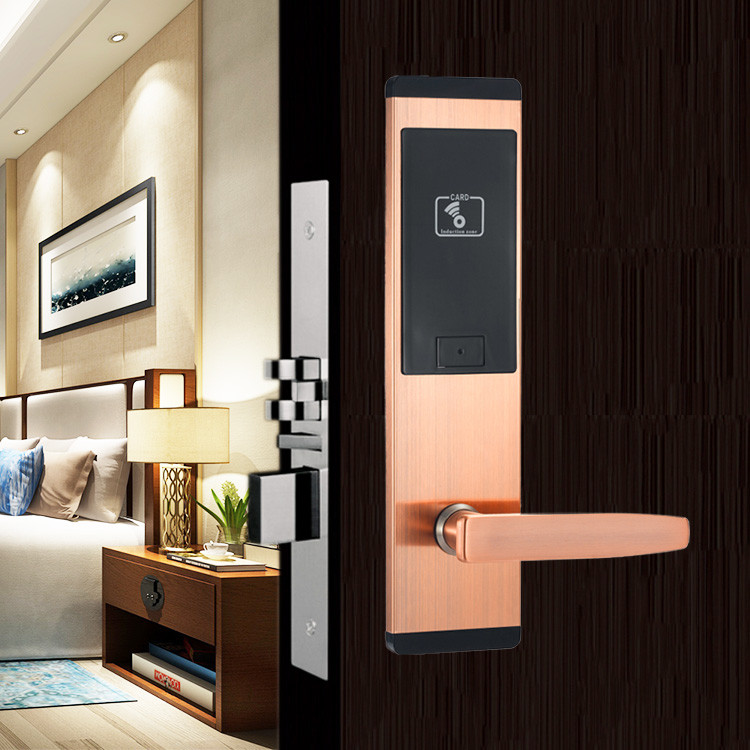
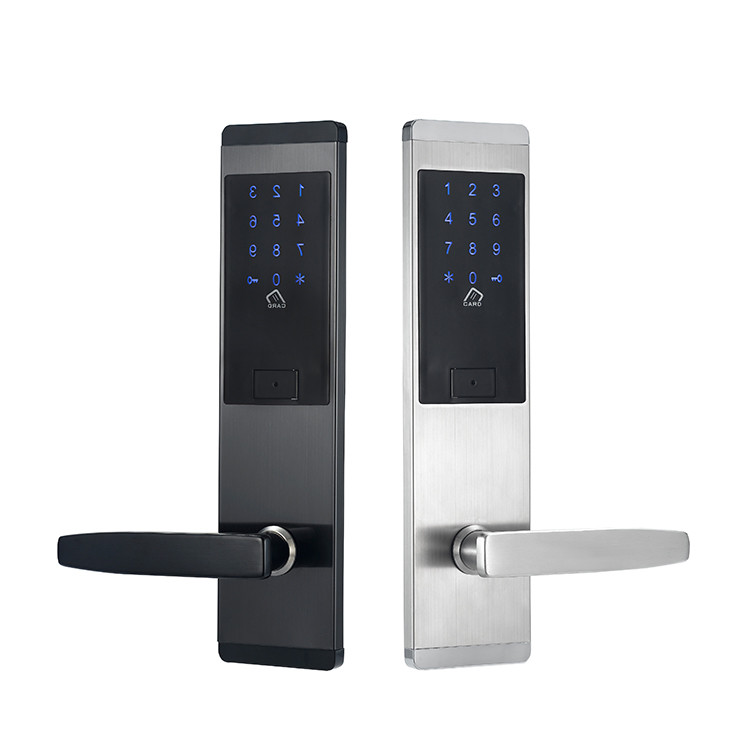
| Aspect | Offline RFID lock | Network-connected lock |
|---|---|---|
| Credential issuing | Front-desk encoder writes cards locally | Issued remotely by software, including mobile keys |
| Check-out expiry | Automatic, written into the card validity window | Automatic, revoked from the platform |
| Access records | Stored in the lock; retrieved with a data collector | Uploaded in real time to the management platform |
| Network dependency | None. A dead router never locks a guest out | Real. Coverage, gateways and power all matter |
| Infrastructure cost | Encoder plus cards, no cabling | Gateways, Wi-Fi planning, IT maintenance |
| Best fit | Budget and mid-scale hotels, renovations, poor network sites | Boutique and upscale properties, self check-in, multi-site operators |
Our field experience in one sentence: offline systems fail on consumables, networked systems fail on infrastructure. Offline projects run into worn-out cards, an encoder that only the night manager knows how to use, or a lost master card. Networked projects run into dead spots in Wi-Fi coverage, gateways powered off during renovation, and firmware updates nobody scheduled. Neither is a reason to avoid either route, but you should know in advance which failure mode your team is better at managing. For a deeper comparison of the two technical routes and their PMS implications, see our hotel door lock system overview.
Decision 3: Card technology, 125 kHz or 13.56 MHz?
Two card families dominate the market, and the price gap between them is small compared with the problems the cheap option creates later.
- 125 kHz (T5557 / EM-style) cards. Read-only identification. Cheap, mature, and adequate for small properties with disciplined front-desk processes. The credential logic is simple, and cards are easy to replace.
- 13.56 MHz Mifare (M1 and CPU) cards. Encrypted sectors with key-pair authentication. The lock and the card exchange encrypted challenge data, which makes casual cloning impractical, and the same card platform can later carry staff, parking or wallet functions. EPROER locks such as the EP-A107 Mifare lock support this family.
For any new build or full refurbishment, we recommend 13.56 MHz. The card costs a little more; the security margin and the upgrade path are worth it. For a 20-room budget property replacing like-for-like, 125 kHz remains a defensible choice.
A note that reassures guests: a hotel key card does not carry the guest's name, payment data or home address. The lock validates a time-limited code, and most incidents reported as "a card opened the wrong room" trace back to front-desk process errors or master-card custody failures, not to the card technology itself. Independent security writers make the same point in detail, for example CardoTel's assessment of hotel key card security.
Decision 4: The lock body, and the door survey everyone skips
The electronic reader gets the attention; the mortise lock body decides whether the door actually closes, latches and survives five years of abuse. Before requesting quotations, walk the floors with a tape measure and record, room by room type:
- Door thickness. Most hotel lock panels are designed for a common range roughly between 38 mm and 55 mm. Fire-door assemblies and older timber doors sometimes fall outside it.
- Existing cut-out and backset. Renovation projects should match the lock body to the existing door preparation where possible. Changing the body specification mid-project means re-cutting doors, which costs more than the locks.
- Door material and edge profile. Wooden, metal-framed and fire-rated doors each have fitting constraints. Aluminium doors with narrow stiles often need a slim escutcheon.
- Handling and swing direction. Left and right handing must be confirmed per room type, not per building.
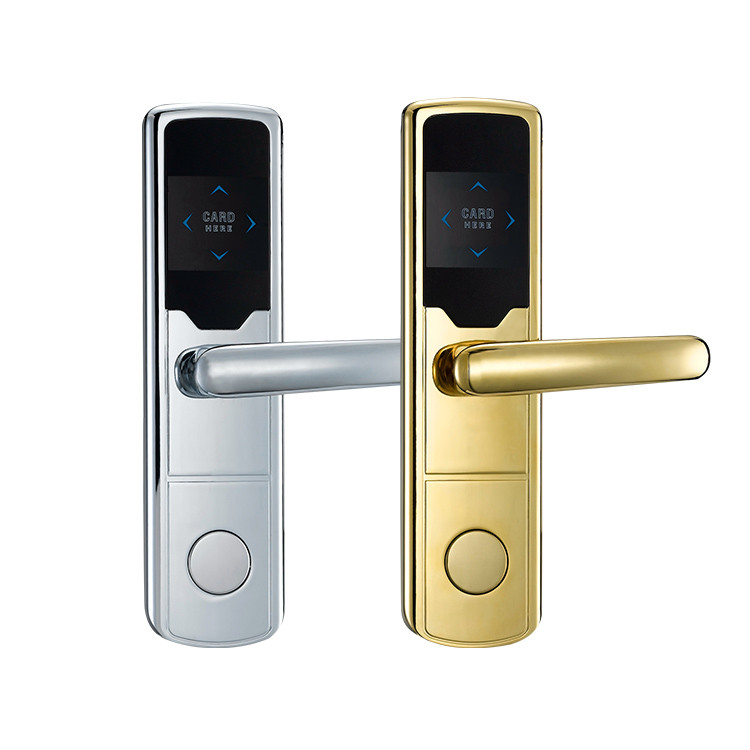
On materials: stainless-steel panels such as those on the EP-A101 ANSI mortise lock resist salt-air corrosion better than painted zinc alloy, which matters for coastal resorts. Zinc alloy offers more finish options at lower cost for inland properties. Both are legitimate choices; the mistake is deciding by catalogue photo instead of by environment.
Two emergency requirements are non-negotiable whatever you buy: a mechanical override key with a documented custody procedure, and an external emergency power contact so a fully flat battery never turns into a guest standing in the corridor at 2 a.m.
Decision 5: Management software and PMS integration
The software is where a lock becomes a system. At minimum, front-desk software must handle: issuing and voiding guest cards, extending stays without a new card, tiered staff cards, and reading the opening record after an incident. Confirm that the software licence is perpetual, not a hidden annual fee, and that the supplier provides it for the number of front-desk workstations you actually run.
If you want the lock to talk to your property management system (PMS), ask four questions before signing:
- Does the supplier offer a documented API, or only a proprietary desktop program?
- Which PMS brands have they integrated with before, and can they name a reference property?
- Who writes the interface: the lock supplier, the PMS vendor, or a third-party integrator, and who pays?
- With an offline system, how are opening records retrieved, and how fresh are they?
Offline locks can be linked to check-in workflows through the encoder software, but records arrive when the data collector pulls them, not in real time. Networked locks feed live events to the platform, which enables mobile keys, remote issuing and genuine self check-in. EPROER supplies both routes, including BLE and Wi-Fi models in the Bluetooth APP door lock range for operators who need remote management today.
Decision 6: Total cost of ownership and supplier due diligence
The lock price on the quotation is usually less than half of what the project spends. Budget the full picture:
- Hardware: locks, one or more card encoders, cards and staff key fobs, spare panels and mortise bodies.
- Software: front-desk licences, PMS interface development if applicable.
- Installation: door survey, fitting, commissioning and staff training. Phased floor-by-floor rollout keeps rooms sellable.
- Life-cycle: batteries, replacement cards (guests take them home), and mechanical wear parts after year three.
Supplier due diligence matters more than unit price because defects surface on site, months after payment. Ask for the certificates relevant to your market and match the certificate model numbers against the quotation, request a sample lock and test it on your actual door, and ask how spare parts are stocked for models you buy. Third-party market research such as the hotel lock market report by Market Growth Reports shows RFID card locks holding the largest share of installed hotel locks worldwide, which also means a deep secondary market in mismatched spare parts; buying from one consistent system avoids that trap.
Pre-purchase checklist
- Hotel-grade lock with automatic check-out expiry and tiered staff permissions
- 13.56 MHz Mifare cards for new builds; documented card issue and void workflow
- Door survey completed: thickness, backset, material, handing, per room type
- Mechanical override key and external emergency power contact, both in the contract
- Software licence terms confirmed: perpetual, workstation count, update policy
- PMS integration questions answered in writing before the purchase order
- Sample lock tested on your own door before bulk order
- Spare parts plan agreed: panels, mortise bodies, cards, batteries
Frequently asked questions
What happens when the lock battery runs out?
The lock gives a low-battery alert well before failure, and continues to operate on the remaining charge for a further period. If the battery does go flat, the mechanical override key and the external emergency power contact are the two standard recovery paths. Both should be part of your purchase contract, and the override key must have a named custodian and a sign-out log.
Can guests open the door with their phone?
Yes, with a Bluetooth or Wi-Fi lock and the corresponding APP or gateway platform. Mobile keys suit boutique and upscale properties with reliable network coverage. Keep physical cards as the fallback for every room, because a guest with a dead phone at midnight does not care about your digital roadmap.
How long does installation take per room?
On a standard wooden door with compatible preparation, an experienced two-person crew typically completes a room in well under an hour, including commissioning. Renovation doors that need re-cutting take longer, which is exactly why the door survey in Decision 4 comes before the quotation.
Can one master card open every room?
Yes, and that is precisely why master cards need tighter control than guest cards. Limit the number issued, keep a sign-out log, and re-code the affected section immediately if a master card is lost. Guest cards are time-limited and room-limited by design; the master card is the credential your audit procedure actually protects.
Sources and further reading
- Hotel Lock Market - Industry Trends and Forecast to 2035, Market Growth Reports: installed-base data on RFID versus other lock types.
- Are Hotel Key Cards Secure? An Honest Assessment, CardoTel: what a key card does and does not store, and how sequential coding works.
- EPROER Hotel Door Lock product range: RFID lock models referenced in this guide, with specifications.
- EPROER Bluetooth APP Door Lock range: connected locks for mobile key and remote management deployments.


